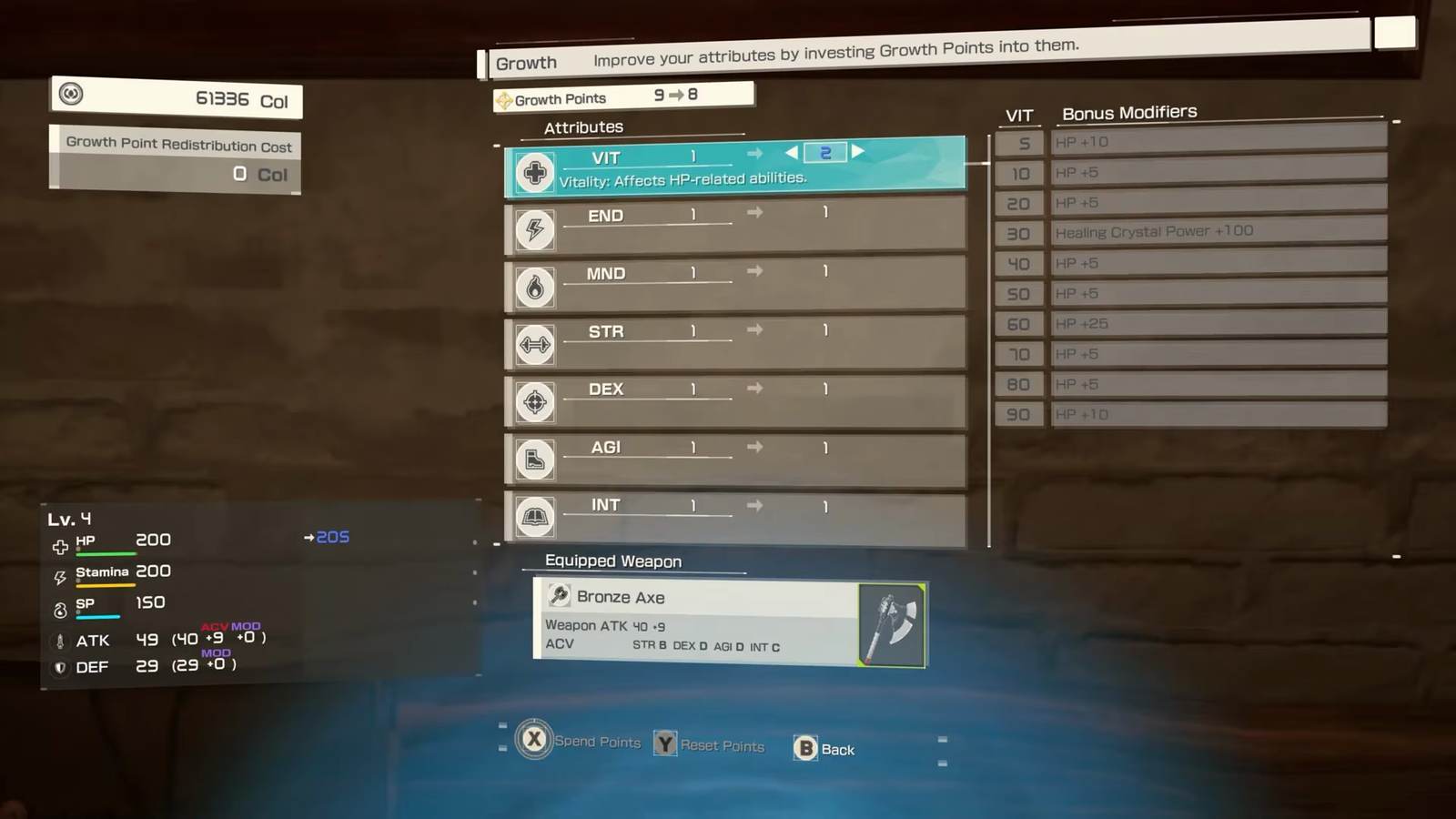
Short version: defeating monsters levels you up, and leveling grants Growth Points. You spend those points on the seven attributes while resting at the Inn in town. Growth Points are how your stat spread actually happens, so treating them as a budget — not scattering them — is the core of building a character. This pairs with the stats guide (what the attributes do) and the creation guide (build templates).
Evidence basis. The Growth Points loop—earn points by leveling and spend them on attributes at the Inn—comes from the official Starter Guide. This page focuses on budgeting decisions and does not rely on undocumented per-level yields or respec assumptions.
The loop: fight, level, invest
Character growth in Echoes of Aincrad runs on a simple, deliberate loop. You defeat monsters out in the field and dungeons, which levels you up. Each level grants Growth Points, a currency you bank rather than spend on the spot. Then, back in town, resting at the Inn lets you pour those points into your attributes. The separation matters: you don't get stronger mid-fight, you get stronger when you return to safety and choose where the growth goes. That makes the Inn visit a small planning moment every few levels — a chance to reassess whether your build is coming together or spreading thin.

Where the points come from
Growth Points are tied to leveling, and leveling is tied to defeating monsters — so the fastest way to more points is simply engaging with combat rather than skipping past it. This rewards clearing the packs of field enemies you might otherwise run past, and it's one reason the open areas beyond the Town of Beginnings are worth exploring rather than beelining the story. Every enemy is incremental progress toward the next level and the next handful of points.
It's worth separating this from Cardinal Rank, which is a different progression track. Your level (from kills) drives Growth Points and your raw power; your Cardinal Rank (from story progress and discovering new towns) gates things like shop stock, craftable recipes, enemy difficulty and drop quality. You raise them through different activities, and a complete character pushes both.

How to budget your Growth Points
The temptation, especially early, is to spend points the moment you have them, evenly, to "stay balanced." Resist it. Growth Points are most powerful when they reinforce one identity. A practical budgeting approach for a first character:
- Pick your lead damage stat (Strength, Dexterity, Agility or Intelligence) based on your weapon, and feed it consistently. This is your damage.
- Keep Vitality and Endurance moving up alongside it — HP and Stamina are what let you actually use your damage. Under-investing here is why fragile builds stall on the first punishing boss.
- Add Mind if you're skill-focused. If your damage comes from big Sword Skills, Mind multiplies them; if it comes from normal attacks, you can skip it.
- Don't touch the stats you're not building. A point in an attribute your build doesn't use is a point your build doesn't feel.
The through-line matches the stats guide: commit to a lead damage stat plus one or two support stats. A focused level-10 character out-performs a level-10 character with points smeared across all seven attributes, every time.
Should you save points or spend them?
Banking a few Growth Points gives you room to correct course if a build direction is not working and to respond to a wall by adding Vitality or Endurance. Unspent points are unused power, so this is not a reason to hoard indefinitely. Spend most points toward your build identity as you earn them, but keep a small reserve for the moment a specific fight reveals what the character is missing.
Three upgrade tracks, not one
Growth Points are only one of three ways your character gets stronger, and confusing them is a common beginner trap. Keeping them straight tells you where to go when you want to improve a specific thing:
- Growth Points → your attributes. Earned by leveling, spent at the Inn, they raise the seven stats — your raw power and resource pools. This is the track this guide covers.
- The Smithy → your gear. Weapons and armor are upgraded, forged and fused with Col and materials, independent of your Growth Points. A maxed stat spread on a weak weapon still underperforms.
- Cardinal Rank → your access. Raised by story progress and exploration, it gates shop stock, recipes, drop quality and enemy difficulty.
A strong character advances all three. If you feel stuck, diagnose which track is lagging: low damage despite good gear usually means your attributes are spread too thin; good stats but weak equipment means you've neglected the Smithy; a stalled shop means you need to push Cardinal Rank. Growth Points fix the first of those, not the other two.
How much to spend per Inn visit
Because you bank points and spend them in batches, each Inn visit is a small decision about how much to commit. A reliable habit: spend the bulk of your points toward your identity as you earn them, but keep a small floating reserve. Dumping every point immediately maximizes your power right now but leaves you nothing to react with; hoarding everything leaves power on the table for no reason. The sweet spot is investing most of each batch into your lead damage stat and your key support stat (usually Vitality or Endurance), while holding back a few points against the next wall. When a boss keeps killing you, that reserve becomes exactly the Vitality or Endurance you needed — no respec required.
Leveling efficiently in the demo
If you want to bank Growth Points quickly, the demo gives you a few honest levers. Clear field packs instead of running past them — the open areas beyond the Town of Beginnings are full of monsters that each chip toward your next level. Use your partner aggressively: Iori's damage speeds up clears, and Combination Skills delete tougher enemies fast, so leaning on the team nets you more kills per minute. And don't skip the optional fights like the field elites — they give more experience than fodder, and beating them is also good practice for the reads you'll need later. None of this is grinding for its own sake; it's just choosing to engage with combat, which is exactly what the leveling loop rewards.
A sample plan for your first ten levels
To make this concrete, here's one reasonable way to spend Growth Points on an early sword-and-shield character — not the "correct" build, just a worked example of the principles above. For your first few levels, split points between Strength (your damage) and Vitality (your HP), so you're hitting harder and surviving longer in equal measure. Around the midpoint, start feeding Endurance so your guarding and dodging don't run you dry against the demo's bosses. Keep a two-or-three-point reserve floating the whole time for emergencies. By level ten you'd have a character with a clear damage identity, a healthy HP cushion, and enough Stamina to fight the Sentry Golem and Illfang without gassing out — and crucially, no points wasted on Dexterity, Agility, Intelligence or Mind that a Strength build simply doesn't use. Swap the damage stat for another weapon's and the same plan holds: lead stat plus Vitality early, Endurance in the middle, a small reserve throughout.
FAQ
How do you earn Growth Points in Echoes of Aincrad?
Where do you spend Growth Points?
What should you spend Growth Points on first?
Does leveling scale enemy difficulty?
Where to go next
Learn what each attribute does in the stats guide, plan a full build in the character creation guide, and understand the other progression track in the Cardinal Rank guide.
Sources
Gameplay frames captured from the Echoes of Aincrad demo; player-captured footage credited in each caption.