Short version: the Smithy is the town facility that handles your gear the way the Inn handles your stats. It does four jobs — create new gear, strengthen what you have, preserve useful effects by fusing weapons (pooling EX-Mods), and help you compare upgrade investments. It runs on Col and crafting materials, and what you can craft expands with your Cardinal Rank. A great stat spread on a neglected weapon still underperforms — the Smithy is how you keep your gear level with your build.
Evidence basis. The Smithy’s create, strengthen and fuse functions come from the official Starter Guide and the playable demo. The strategy is organized around those documented systems without inventing recipe lists, material costs or upgrade caps.
The Smithy's four jobs
It helps to think of the Smithy as four connected services rather than one "upgrade" button:
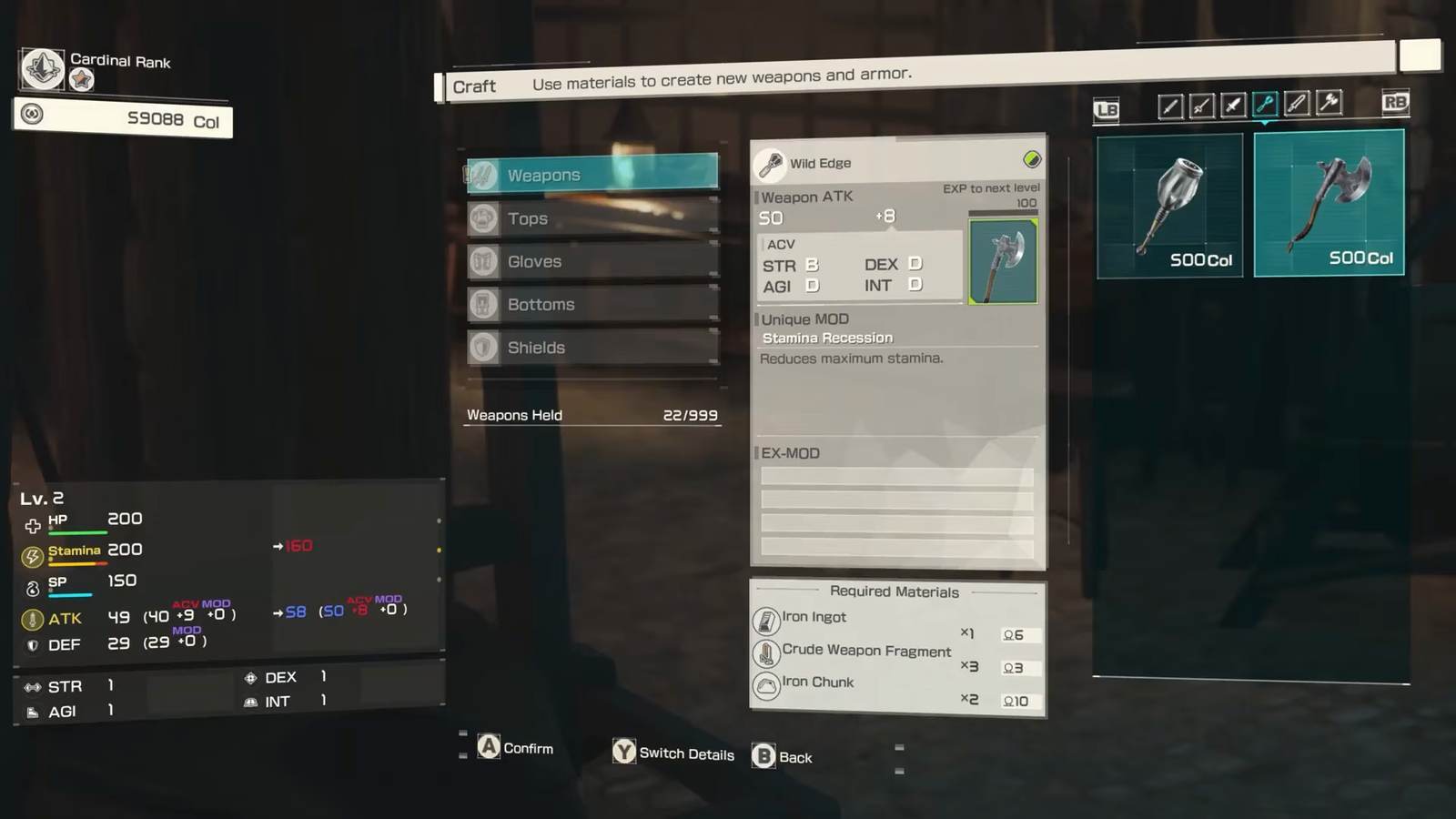
- Create gear — craft new weapons and armor from blueprints and materials. The Proto-Elucidator pre-order pack's blueprints point straight at this loop.
- Strengthen gear — level up a weapon or piece of armor you already own, raising its stats with Col and materials.
- Preserve useful effects — fuse weapons of the same type to carry over and pool their EX-Mods, so a good random effect isn't lost when you move to a better base weapon.
- Compare investments — the Smithy helps you weigh which upgrade is worth your limited materials, so you're not pouring rare mats into a weapon you'll outgrow.
Together these turn a pile of monster drops into a weapon that keeps pace with the fights ahead. Ignore the Smithy and your damage quietly falls behind, no matter how well you've spent your Growth Points.
The materials you'll be collecting
Upgrades aren't just a Col sink — they demand materials, and knowing what feeds the Smithy changes how you play the field. Weapon upgrades can require Col plus a mix of route materials (harvested from the field and dungeons), monster parts (dropped by enemies you defeat), ingots, and key upgrade items like Tempered Steel. The practical consequence: the enemies and nodes you might skip are also your upgrade economy. Clearing packs and harvesting as you explore isn't a detour from progression — it is progression, feeding both your levels and your Smithy. Rarer, higher-tier upgrades lean on rarer materials, and since drop quality scales with Cardinal Rank, the best materials come from staying current on both progression tracks. Every confirmed material type is cataloged in the items & materials database.

Strengthen, create, or fuse?
With limited Col and materials, the Smithy is really a series of investment choices. Here's how to think about each path:
- Strengthen your current main weapon when it's carrying you well and you just want it to keep up — the safe, steady investment.
- Create a new weapon when you've unlocked a better base (or want to try a new type) and have the blueprint and materials for it.
- Fuse when you have two weapons of the same type and want to combine their EX-Mods onto one — the key to building a weapon with a stack of complementary effects rather than one good roll.
The "compare investments" tool exists precisely because these compete for the same materials. The temptation is to spread upgrades across everything you own; the better instinct, as with stats, is to concentrate — pour materials into the one weapon your build is actually using, and don't invest in gear you're about to replace.

When to upgrade, and when to wait
Because materials are finite and some are rare, the timing of an upgrade matters as much as the upgrade itself. The trap is pouring hard-won mats into a weapon you're about to replace. A few rules of thumb keep your investment efficient. Strengthen a weapon you're confident you'll keep for a while — your settled main, not a stopgap you picked up an hour ago. Hold rare materials like Tempered Steel for a weapon that's proven itself, rather than spending them on the first thing that accepts them. And let Cardinal Rank catch up before chasing the most expensive upgrades: since better recipes and materials unlock with rank, an upgrade that feels out of reach now may be cheaper and stronger a rank later. The "compare investments" tool exists for exactly this judgment call — use it to see whether an upgrade is worth its materials before you commit, not after. Patience with your rare mats is itself a form of optimization, and it's the habit that separates a smooth gear curve from a stalled one.
Don't forget your partner's gear
The Smithy isn't just for your weapon. Your partner's equipment is customizable too, and an under-geared partner is a weak link — a feeble Switch target and a soft Combination Skill. When you budget Col and materials, budget for two characters, not one. It's easy to pour everything into your own weapon and treat the partner as free labor, but partner power scales with investment just like yours. A balanced pair beats a maxed solo weapon with a neglected companion, especially in the boss fights where you rely on trading aggro.
Weapons swap at the Inn, upgrades happen at the Smithy
One structural detail worth internalizing: you change which weapon you're wielding at the Inn, between quests — not freely mid-quest — while the Smithy is where that weapon gets built. So your loadout for a given stretch of play is a decision you make in town, then live with until you're back. This rewards a little planning: before heading out, upgrade the weapon you intend to use, make sure its Sword Skills suit what's ahead, and gear your partner to match. Arriving at a boss Ark — where there's no shop — with an under-upgraded weapon is a mistake you can only fix by retreating.
In the demo
The demo introduces the Smithy in the Town of Beginnings, where you can strengthen your starting gear and start feeling out the crafting loop before the full game's deeper systems open up. Because your demo progress transfers to launch, materials and upgrades you invest in now carry forward — and the habit of routing back to the Smithy after a stretch of fighting is one worth building early. Treat every field trip as both a combat session and a shopping run for materials, and your gear never falls behind your ambitions.
Blueprints and crafting from scratch
Beyond strengthening what drops, the Smithy lets you create gear from blueprints — and the pre-order Proto-Elucidator pack tips the game's hand by bundling blueprints alongside its weapons. That tells you crafting-from-plans is a real path, not a footnote: you'll acquire blueprints, gather the materials they call for, and forge specific weapons rather than only upgrading random finds. The practical takeaway is to treat blueprints as goals that direct your material gathering. When you unlock a blueprint for a weapon that suits your build, it becomes a shopping list — the monster parts, ingots and route materials it needs are now worth prioritizing on your field trips. This is the difference between a passive economy (upgrade whatever you happen to find) and an active one (gather deliberately toward a weapon you've decided to build), and the Smithy supports both. For a build with a clear identity, blueprint crafting is how you get the exact weapon that identity wants instead of settling for the best drop.
FAQ
What does the Smithy do in Echoes of Aincrad?
What materials do you need to upgrade weapons?
How do you get better Smithy recipes?
Can you change weapons any time?
Where to go next
Learn the random effects the Smithy preserves in the EX-Mods guide, fund your upgrades in the Col & economy guide, and unlock better recipes by advancing Cardinal Rank.
Sources
Gameplay frames captured from the Echoes of Aincrad demo and official Weapon Overview; player-captured footage credited in each caption.