Aincrad (アインクラッド, Ainkuraddo — from "An Incarnating Radius") is the 100-floor floating castle that serves as the setting of Sword Art Online, the virtual reality MMO at the center of the SAO franchise. It's a massive steel structure suspended in a virtual sky, shaped like an inverted cone — each floor smaller than the one below, each floor its own world. Towns, fields, forests, lakes, dungeons, and a floor boss guarding the stairway to the next level.
In the franchise, Aincrad is both the most ambitious game world ever built and the most elaborate trap ever designed. In Echoes of Aincrad, you live inside it — fighting, crafting, and climbing through the first two floors of the castle that defined the entire SAO universe.
The structure: 100 floors, each its own world
Aincrad's architecture is deceptively simple in concept and overwhelming in scale. The castle is a stack of 100 circular floors, each roughly 10 kilometers in diameter at the base and shrinking as you ascend. Each floor contains:
- A main settlement: a town or city where players rest, trade, take quests, and organize. The Town of Beginnings on Floor 1 is the largest, housing thousands of players at the start of the game.
- Field areas: wilderness zones with monsters, resources, and exploration. These range from grasslands and forests on Floor 1 to deserts, snowfields, and stranger environments on higher floors.
- Dungeon areas: combat-focused zones with stronger enemies and better rewards. Each floor's main dungeon typically leads to the floor boss.
- A floor boss: a powerful enemy guarding the stairway to the next floor. Defeating the boss is the only way to progress. In the franchise, floor-boss raids are the defining events of each floor — alliances form, strategies are debated, and players die.
The floors don't repeat. Each one has a distinct biome, architecture, and atmosphere — Floor 1 is pastoral and European-styled, higher floors introduce swamps, canyons, ice fields, and increasingly alien environments. The variety is part of Kayaba's design: a game world ambitious enough that players would want to explore it even if they weren't trapped inside.

The creator: Kayaba Akihiko
Kayaba Akihiko (茅場晶彦) is the architect of Aincrad — both the game world and the trap. A genius programmer and neuroscientist, Kayaba designed the NerveGear (the full-dive VR headset that interfaces directly with the brain) and Sword Art Online (the game that runs on it). He spent years building Aincrad as the ultimate VRMMORPG — a world so detailed, so ambitious, that it would justify the technology he'd created to experience it.
Then, on SAO's launch day, he locked 10,000 players inside. The NerveGear became a trap: attempting to remove it would fry the user's brain. Dying in the game would trigger the same lethal mechanism. The only escape was to clear all 100 floors and defeat the final boss on Floor 100. Kayaba's motivation — revealed late in the franchise — wasn't cruelty or power. He wanted to see if a world he'd built could become real to the people living in it. Aincrad wasn't just a prison; it was an experiment in whether a virtual world could matter as much as the real one.
In Echoes of Aincrad, Kayaba's presence is felt through the world itself — the rules, the floor structure, the Cardinal System that governs progression. He doesn't need to appear on screen to be the reason every fight matters.
The Death Game: why Aincrad isn't just a game world
What transforms Aincrad from an impressive game setting into the defining premise of the franchise is the Death Game — Kayaba's announcement on launch day that death in SAO means death in reality. For a full breakdown of the franchise concept and how the game adapts it, see The Death Game Explained.
The practical effect on Aincrad as a world: every floor becomes a survival challenge rather than a leisure activity. Players can't log out, can't quit, can't take a break. The towns become refugee camps as much as rest points. The fields become hunting grounds where a bad fight means permanent death. And the floor bosses become existential crises — clearing one means progress toward freedom, but attempting one means risking everything on a fight you might lose.
This tension is what gives Aincrad its weight. It's not just a fantasy setting with a hundred levels — it's a place where every system, every mechanic, every fight has real stakes. Echoes of Aincrad's Death Game Mode recreates this mechanically by deleting your save on death, but the narrative weight of Aincrad as a trap — a beautiful, dangerous world you can't leave — is woven into the story regardless of which difficulty you play on.
Floor 1: where it all begins
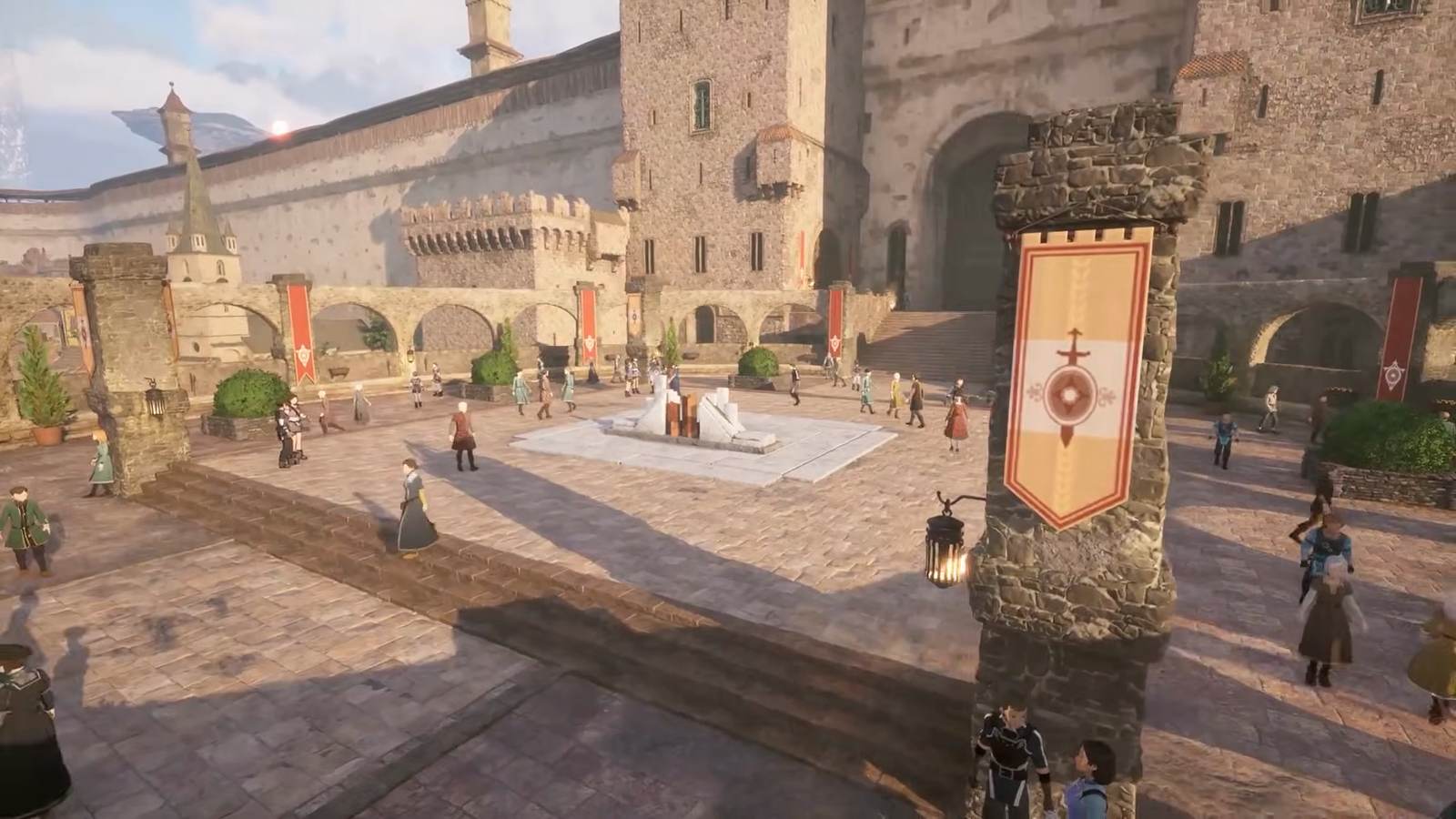
Floor 1 is the ground level of Aincrad and the starting point for both the franchise and the game. In the franchise lore, Floor 1 is where the first month of the Death Game plays out — 2,000 players die before the first floor boss is even attempted, guilds form out of necessity, and the raid against Illfang the Kobold Lord becomes the defining moment of early Aincrad. For a detailed breakdown, see Floor 1 & Floor 2.
In Echoes of Aincrad, Floor 1 contains the Town of Beginnings (with the Inn, Smithy, Merchant, and quest board), the prologue dungeon, field areas for exploration and combat, and the Ark bosses. The game's version of Floor 1 draws from the franchise setting but tells its own story with its own characters — you'll recognize the landmarks if you know the anime, but you don't need to.
The Cardinal System
Aincrad runs on the Cardinal System — the AI infrastructure that manages the game world. Named after a concept in the light novels, Cardinal handles everything: enemy AI, item drops, quest generation, and the rules that govern progression. In the franchise, Cardinal is effectively the operating system of Aincrad — autonomous, self-correcting, and occasionally unpredictable.
In Echoes of Aincrad, the Cardinal System manifests as Cardinal Rank — a progression track that gates shop inventory, crafting recipes, enemy difficulty, and drops based on your exploration and quest completion. It's a mechanical abstraction of the lore concept: the system is watching, and the more you engage with its world, the more it opens up to you.
Why the game is set on Floors 1 and 2
Aincrad has 100 floors. The game covers two. That sounds like a fraction — and it is — but Floors 1 and 2 are narratively and mechanically the right starting point for several reasons:
- Narrative weight: Floor 1 is where the Death Game begins, where the first communities form, and where the first boss raid defines the story's direction. More happens on Floor 1 than on most later floors combined.
- Mechanical scope: two deeply detailed floors with full systems (Smithy, EX-Mods, Cardinal Rank, six weapon types, partner system) offer more depth than ten thin floors would. The game bets on density over breadth.
- Franchise grounding: SAO Progressive — the retelling of the Aincrad arc that covers each floor in detail — has reached Floor 8 as of the latest novels. The early floors are the most fleshed-out in the source material, giving the game the richest foundation to draw from.
- Expansion boundary: the store lists a separate Expansion DLC, but it does not identify a floor. This guide therefore keeps the base-game setting at Floors 1–2 and does not label the DLC as Floor 3.

Aincrad in the broader SAO timeline
For franchise context: the Aincrad arc — the first and most iconic storyline of SAO — covers the two years players spend trapped in the floating castle, from the launch-day trap to the eventual clearing of Floor 75 (not 100, for reasons the anime/novels explain). After Aincrad, the franchise moves to other virtual worlds (Alfheim Online, Gun Gale Online, the Underworld), but Aincrad remains the setting that defines the series.
Echoes of Aincrad returns to the beginning of that story — Floor 1, the Death Game's first days, the characters and world at their most desperate and hopeful. Whether you know the full franchise timeline or not, the game's setting is self-contained: Aincrad is a floating castle, you're trapped inside, and you need to fight your way up. Everything else is enrichment, not prerequisite.
For a guide on how much franchise knowledge helps: Do You Need to Watch SAO?
FAQ
What is Aincrad?
Who created Aincrad?
How many floors does Aincrad have?
Does Echoes of Aincrad cover all 100 floors?
Where to go next
Explore the world: Floor 1 & Floor 2, locations database. Understand the stakes: The Death Game Explained. Meet the people: characters lore guide and character database.
Sources
- Sword Art Online light novel series (Reki Kawahara, ASCII Media Works / Kadokawa)
- Sword Art Online Progressive light novel series (Reki Kawahara)
- Bandai Namco — Starter Guide
Franchise lore from the light novels and anime. Game-specific details from official materials and the demo.